Gilman Arthur Drew, 1868 - 1934
by Brian Stevenson
last updated January, 2026
Gilman Drew produced and exchanged microscope slides during the early 1890s, when he was a school teacher in Iowa, USA (Figure 1). His slides and exchange information gave his parent’s address of Newton, Iowa. Gilman left Iowa ca. 1895, to work on a Ph.D. at Johns Hopkins University, in Baltimore, Maryland. He then served as a Biology Professor at the University of Maine, and later as Assistant Director of the Woods Hole Marine Biological Laboratory, in Woods Hole, Massachusetts.
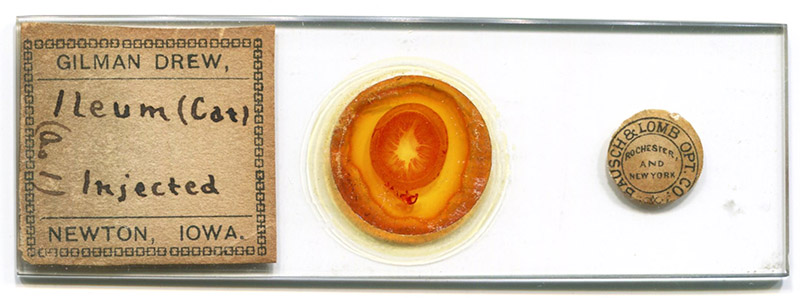
Figure 1.
Microscope slide that was prepared by Gilman Drew ca. early 1890s. He offered to exchange histological slides through “The Naturalists’ Directory” between 1890 and 1895. This slide also bears a label from The Bausch and Lomb Optical Company; Drew is not known to have worked for B&L or any other such company, so it is most likely that the slide was somehow acquired by that retailer, then re-sold.
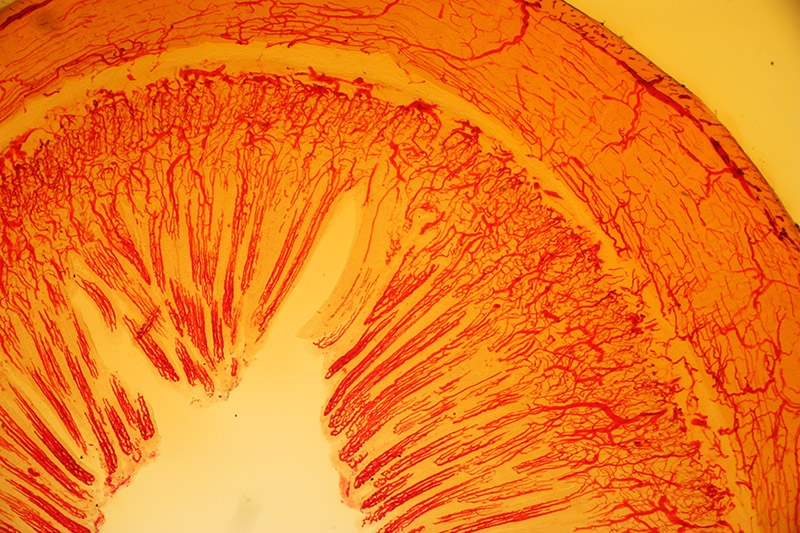
Figure 2.
Transverse section of “Ileum (Cat), injected”, by Gilman Drew (see Figure 1). Imaged with a 3.5x objective lens and C-mounted digital SLR camera on a Leitz Ortholux II microscope.
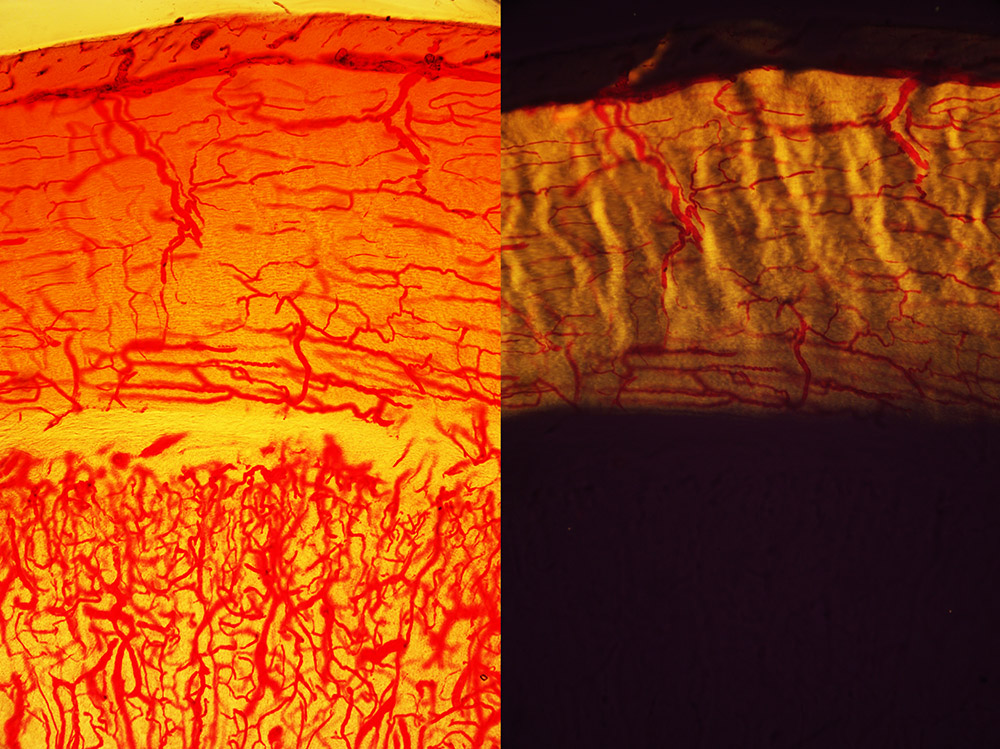
Figure 3.
Transverse section of “Ileum (Cat), injected”, by Gilman Drew (see Figure 1). Imaged with a 10x objective lens and C-mounted digital SLR camera on a Leitz Ortholux II microscope, with (left) normal transmitted light, and (right) between crossed polarizing filters. Fibers of the muscularis propria give striking views with crossed polars.
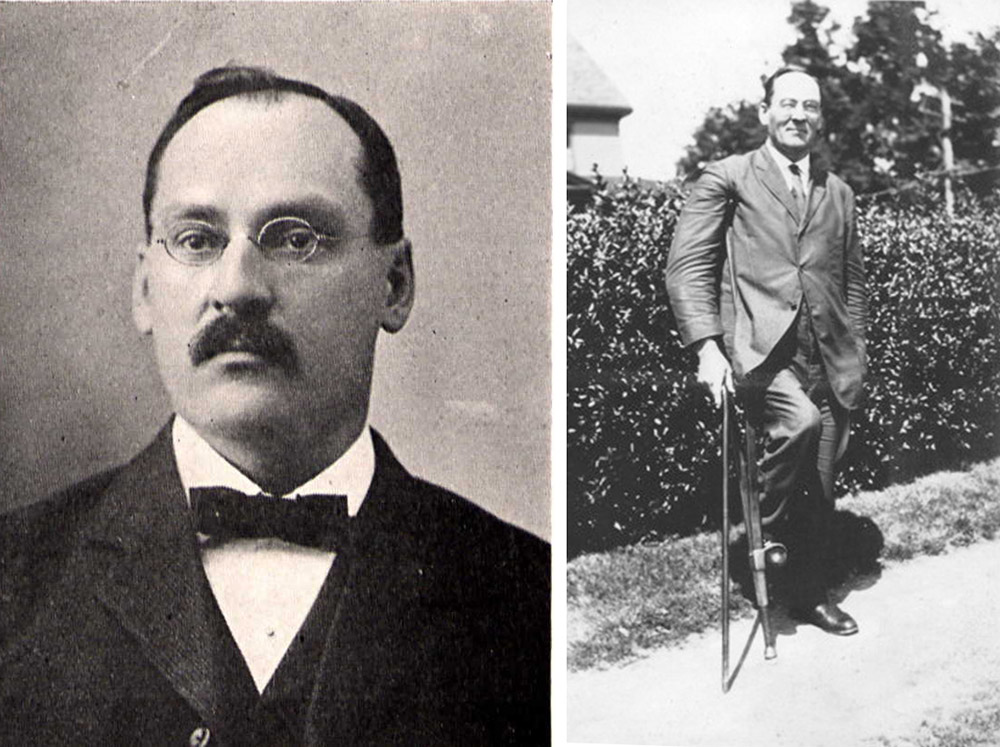
Figure 4.
Gilman Drew when he was (left) a Professor at the University of Maine, ca. 1901, and (right) Assistant Director of the Assistant Director of the Woods Hole Marine Biological Laboratory, 1921. Drew had a weak right leg, probably a result of polio, and used a crutch when walking. Adapted from the University of Maine Yearbook and https://history.archives.mbl.edu/digital-collection/gilman-drew
Gilman Drew was born on November 15, 1868 in Newton, Iowa. He was the second of two sons of Orrin and Mary Emily Drew. Father Orris was a farmer.
Drew attended the State University of Iowa (now the University of Iowa), in nearby Des Moines, graduating with a Bachelor of Science degree in 1890. He then worked as a science teacher in Oskaloosa and Des Moines. Drew evidently began teaching in Oskaloosa before completing his degree, as published an article on survival mechanisms of frogs in 1889, giving that city as his address.
He was also active as an amateur microscopist during his time as a school teacher. The Naturalists’ Directories of 1890 through 1895 include entries for Drew that described him as interested in collecting and exchanging material related to histology, morphology, and mollusks. He was not listed prior to 1890, nor after 1895, implying that Drew’s microscope slides that are labeled “Iowa” were produced between those dates. He probably used his parents’ address of Newton on his slides and in The Naturalists’ Directory due to his moving around for teaching jobs.
Gilman Drew married Lena Slawson on November 24, 1892. They did not have any children.
In May, 1893, “The State University of Iowa sends a party of about twenty specialists to the Bahama Islands the first of May, to spend four months in scientific research. A vessel has been chartered on which the party will make their home during that time. The study of sea dredgings will be a part of their work. Mr. Gilman A. Drew, the science teacher in the Oskaloosa High School and the science teacher in the West Des Moines High School are admitted to membership in the Bahama scientific party”. Lena Drew was also a member of the Bahama expedition, which chartered “a two-masted schooner … cheaply yet conveniently fitted up for the occasion, by flooring over the hold and placing comfortable bunks, tables, etc., in the after part. A convenient laboratory for marine biology and a good library of reference were provided by the University. The cabin was furnished with all necessary comforts for the ladies who accompanied the expedition. A cheap and effective dredging equipment … furnished a means of working down to about 260 fathoms”.
Gilman and Lena moved to Baltimore, Maryland ca. 1895. He earned his Ph.D. from Johns Hopkins University in 1898, then worked for two years as an assistant to Zoology Professor William Brooks (1848-1908).
In 1900, the University of Maine announced, “Gilman Arthur Drew, Ph.D., has been appointed Professor of Biology to succeed Prof. Harvey. The title has been changed, from Professor of Natural History and Entomologist to the Experiment Station, to Professor of Biology and Zoologist to the Experiment Station. Prof. Drew was born in Iowa in 1863; received the degree of B.S. from the University of Iowa in 1890 and that of Ph.D. from Johns Hopkins University in 1898. After leaving college, he was teacher of science in an academy and in a high school in Iowa. At Johns Hopkins University he held successively, a scholarship, a fellowship, and the Bruce Fellowship, and for the last two years was assistant in zoology. His summers have been spent in collecting and investigating among the mountains and along the coast of California; in the West Indies and Bahama Islands; at Cold Spring Harbor, N.Y.; at Beaufort, S.C.; at Woods Hole, Mass.; and at Harpswell, Me. Prof. Drew has published a number of important papers embodying the results of his studies.”
In 1907, Drew published A Laboratory Manual of Invertebrate Zoology. New editions of the book were published over the next several decades.
Drew also worked and taught courses at the Woods Hole Marine Biological Laboratory during this time, He was appointed Assistant Director in 1909. Drew resigned his Maine faculty position in 1911, to work full-time at Woods Hole.
Winterton Curtis (1875-1969) wrote of working for Drew at Woods Hole, “Although I had resolved not to teach in the summer but have my time for research, I went back to the Invertebrate Course in 1902 and ’03. I needed the money. Prof. Gilman A. Drew of the University of Maine was then in charge. Later, he became resident director of the Laboratory. I had known Drew at the Hopkins. He was a remarkable man. Crippled in one leg when a child, I presume by polio, he walked with a crutch but this was no overpowering handicap for a man of his determination. His crutch was better than the second leg of most men. As a boy he had played the kicking game of football that was then in vogue. He rode a bicycle of the old ratchet type that had a brief existence in the nineties. He could jump a fence that was armpit high by using his crutch as a vaulter would use his pole. With a leather disk attached to the base of his crutch he could go about the flats and dig for worms in three feet of water with the best of us. From his legs up he was built like a bull, and his good leg was as good as any two in the laboratory. How he did make things go, although he did this by main strength and awkwardness as he stumped about. … Mrs. Drew was like her man, a big, strong woman and a driver on work. They both had their prejudices, notably those against tobacco, liquor, and Southerners. … Both Drew and his lady were products of the Iowa farm belt. Although I liked and admired them intensely, I am always reminded of them when I see Grant Wood’s picture, ‘Iowa Gothic’.”
Drew retired in 1926, he and Emily setting in Eagle Creek, Florida. He maintained an orange orchard, and was also active in agricultural affairs of the state. Gilman Drew died there on October 26, 1934 “after a lingering illness”.
Acknowledgement
Thank you to Jeff Silverman for helpful comments on Gilman Drew's preparation of ileum tissue.
Resources
Biennial Report of the President of the University of Maine (1900) Gilman Arthur Drew, Ph.D., page 8
Bulletin of the University of Maine at Orono (1911) “Resignations: Gilman Arthur Drew, Ph.D., Professor of Biology”, page 5
Curtis, Winterton C. (1955) Good Old Summer Times at the M.B.L. and Rhymes of the Woods Hole Shores, Curtis, pages 9-10
Drew, Gilman (1889) Some reasons why frogs are able to survive, Proceedings of the Iowa Academy of Science, Vol. 1, pages 32-35
Drew, Gilman A. (1906) The Habits, Anatomy, and Embryology of the Giant Scallop, (Pecten Tenuicostatus, Mighels), University of Maine, Orono
Drew, Gilman A. (1907) A Laboratory Manual of Invertebrate Zoology, W.B. Saunders, Philadelphia
Drew, Gilman A. (1907) Hens that have laid two eggs in a day, Science, Vol. 26, pages 119-120
Drew, Gilman A. (1928) A Laboratory Manual of Invertebrate Zoology, Fourth Edition, W.B. Saunders, Philadelphia
Journal of Education (1893) paragraph on the Iowa Bahama Expedition, page 220
Lillie, Frank R. (1934) Gilman A. Drew, 1868-1934, Science, Vol. 80, pages 470-471
The Naturalists' Directory (1886) Gilman Drew not listed
The Naturalists' Directory (1888) Gilman Drew not listed
The Naturalists' Directory (1890) “Drew, Gilman, Newton, Jasper Co., Iowa. Histol., Moll. C. Ex.”, Cassino, Boston, page 51
The Naturalists' Directory (1894) “Drew, Gilman, Newton, Oskaloosa, Mahaska Co., Iowa. Morphol., Histol., Moll. C.”, Cassino, Boston, page 65
The Naturalists' Directory (1895) “Drew, Gilman, Newton, Jasper Co., Ia. Morphol., Histol., Moll. C.”, Cassino, Boston, page 54
Nutting, C.C. (1893) History of the Bahama Expedition, Annals of Iowa, pages 298-302
University of Maine Yearbook (1910) Gilman Arthur Drew, Ph.D.
USA census and other records, accessed through ancestry.com